If you entered into an engineering, procurement, and construction (EPC) agreement before the summer of 2026 for a solar, wind, storage, or hybrid project, inverter compliance was likely covered by a general compliance-with-law clause, similar to the way most equipment risk is handled. That clause likely does not expressly reference a federal list of restricted equipment, which can change within weeks. Between July 28 and August 26, 2026, two federal actions put foreign-produced inverters squarely in the path of project procurement.
A hard question for owners and contractors is how much risk each side should carry for inverters becoming restricted equipment. The negotiated contract language will answer who bears what risk, and if not specifically addressed, the risk will fall more heavily on the owner, usually through the change-in-law clause. This post summarizes what this summer’s federal actions have changed, offers ways to think about who should bear which risk, and sets out several ways to draft the key provisions, which could place more risk on either the contractor or the owner.
What changed, in brief
The FCC
On July 28, 2026, the Federal Communications Commission (FCC) added foreign-produced power inverters, along with advanced robotic devices, to its Covered List of equipment deemed a national security risk. Items on the list cannot receive FCC equipment authorizations, and therefore generally cannot be imported, marketed, or sold in the United States. Previously authorized models (those that received an FCC equipment authorization before July 28, 2026) may still be produced, imported, marketed, and used unless the FCC revokes or limits their authorizations. Under 47 C.F.R. § 2.939, the FCC can do that by revoking an authorization, or by public notice (with at least 30 days for comment) limiting further importation and marketing for a class of devices or an entire Covered List entry. It has used that process for older entries but, as of this writing, has not proposed it for inverters. A blanket waiver allows certain software and firmware updates for those legacy models until at least January 1, 2029. Manufacturers can also seek confirmation that a specific model is not subject to the Covered List (“Conditional Approval”) from the Department of War (DoW) or the Department of Homeland Security (DHS). Inverter Conditional Approvals began issuing in October 2026, and the FCC lists them on its website.
On August 20, 2026, the FCC narrowed the Covered List entry for foreign-produced power inverters to cover only utility-interactive inverters as defined in UL 1741 (a UL listing is not itself required for coverage). The FCC also confirmed that an inverter designed or configured to accept a connectivity component, including a wired interface such as Ethernet, is covered even if that component is not installed. An inverter that is not designed, equipped, or configured to accept a remote-connectivity component falls outside the entry. Inverters eligible for the Section 45X advanced manufacturing credit are no longer treated as foreign-produced, nor inverters that are a “domestic end product” under 48 C.F.R. § 25.101(a), which requires U.S. manufacture and domestic component costs above 65 percent through 2028 and 75 percent beginning in 2029. The FCC has not published a device-level list, so a project team may need production-location, domestic-content, and 45X information from the manufacturer, along with each model’s FCC ID, grant date, and any Conditional Approval, to know whether an inverter is considered foreign-produced.
Executive Order 14421
On August 26, 2026, the president issued Executive Order 14421 (EO 14421), declaring a national emergency over foreign-produced bulk-power system equipment and authorizing the Department of Energy (DOE) to prohibit or condition certain transactions. It uses a different test than the FCC: a connection to a “Covered Foreign Entity,” rather than the place of production. The order expressly names utility-scale and other grid-connected inverters and battery storage, but it reaches only the bulk-power system, so its application to smaller or distribution-level projects is uncertain until DOE’s rules issue. A Covered Foreign Entity is defined by reference to countries under U.S. arms embargoes or sanctions, including China and Russia, and any others DOE designates. The order reaches not only hardware but also critical components, software, firmware, digital services, maintenance services, and remote-access capability. The order applies to transactions initiated after August 26, 2026. The order does not define when a transaction is “initiated,” and it applies notwithstanding contracts signed before it, so purchase orders and deliveries under pre-existing supply agreements deserve attention. DOE has until December 24, 2026, to publish implementing rules (DOE issued a request for information in September, and comments closed October 9), and a transaction is prohibited only if DOE makes the determinations the order requires. The order also lets DOE impose conditions on equipment installed before it took effect.
The result is two regimes with two different tests and a rulemaking still underway. A contract cannot remove that uncertainty, but it can decide who carries it.
Start with who controls the risk
Every inverter provision answers one question: if something goes wrong, whose problem is it? A useful way to answer is to ask who controls each source of risk.
- Sourcing. The contractor usually selects the manufacturer and negotiates the supply agreement. Therefore, the contractor is in the best position to confirm where an inverter was made, what components it contains, and whether the model holds a pre-July 28, 2026 FCC authorization or a Conditional Approval. Therefore, it is reasonable to place the risk of non-compliance at delivery on the contractor.
- Future government action. Neither party controls what the FCC, DOE, or the White House does next. The FCC can still limit previously authorized models, and in earlier cases it did so with little transition time. Assigning that risk entirely to one side tends to produce either a large contingency in the price or a dispute later. Shared mechanisms, such as a dated baseline, a reopener, and a cooperation clause fit better.
- Operation after handover. Once the project is running, the owner controls network architecture, remote-access settings, and the operations and maintenance (O&M) vendors. Cybersecurity and remote-access configuration after handover generally belong with the owner.
Four provisions, three postures
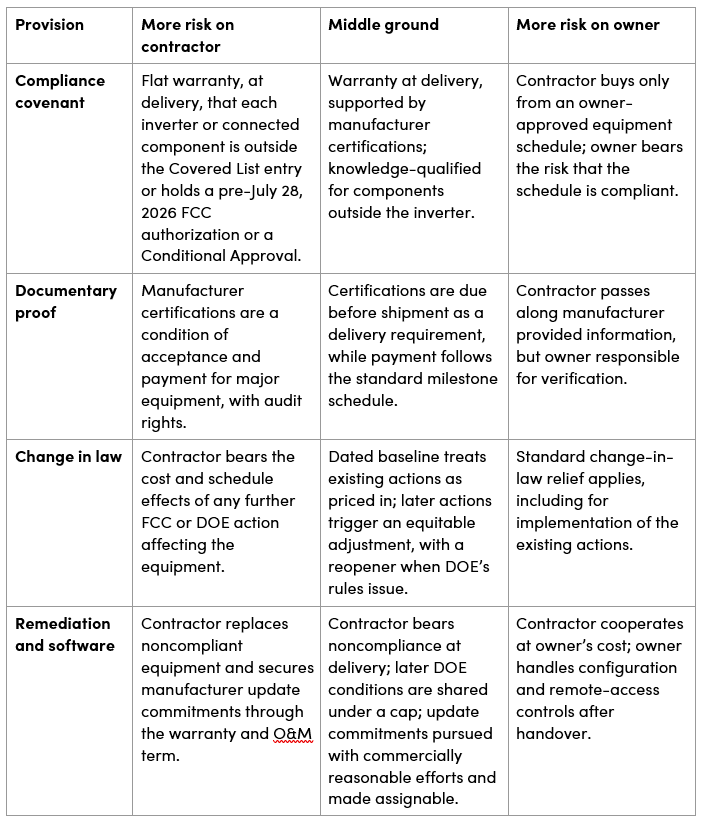
The table below shows how four key provisions can be drafted to move the risk toward the contractor or toward the owner. These points are on a spectrum, and a negotiated provision often borrows from more than one column.
Compliance covenant
The most owner-favorable version is a representation and warranty by the contractor that each inverter or connected component is outside the Covered List entry or holds a pre-July 28, 2026 FCC authorization or a Conditional Approval at delivery. Framing the warranty around whether an inverter is “covered” would be too blunt: a foreign-produced inverter with a pre-July 28 authorization is within the category but can still be lawfully imported, sold, and used. But contractors will resist this because the FCC has not published a device-level list. The middle position ties the warranty to manufacturer certifications through delivery. The most favorable version for the contractor requires that the owner approve an equipment schedule and bears any risk so long as the contractor purchases in compliance with that schedule.
Documentary proof
Because there is no device-level list, it is important to require the manufacturer to provide: place of manufacture, domestic component cost percentage, 45X eligibility, the FCC ID and grant date for each model, any Conditional Approval, and the identity of every remote-connectivity component, including any port or slot designed to accept a connectivity component, as well as the ownership and control of the manufacturer and of the providers of key components, firmware, and remote services, which matters under EO 14421. Requiring that certifications be a condition of acceptance and payment for major equipment gives the owner the most leverage. Requiring certification before shipment is a common middle path. Allowing the contractor to pass manufacturer information but having the owner responsible for verification is the contractor-favorable method. Whichever you choose, 45X eligibility and domestic content percentages are tax determinations, and the FCC’s test applies different standards than the tax rules. Many owners already collect similar records for domestic content bonus credits and prohibited-foreign-entity rules. The contractor’s certification should match what the manufacturer certifies for tax purposes and what the owner will represent to tax equity investors and lenders, because inconsistent representations create their own problems.
Change in law
Most EPC forms treat post-signing changes in law as compensable and excusable. In this scenario, the parties have pre-notice of an upcoming change in law (EO 14421, which directs DOE to publish implementing rules by December 24, 2026), so a reopener can sit alongside the baseline so that both sides revisit price and schedule once the rules issue, rather than guessing now. Illustrative language:
The Parties acknowledge the FCC actions of July 28, 2026, and August 20, 2026, and Executive Order 14421, and agree that the Contract Price and Project Schedule account for them. Within [30] days after DOE publishes final rules implementing Executive Order 14421, either Party may notify the other that the rules affect the Work. The Parties shall then negotiate in good faith an equitable adjustment to the Contract Price and Project Schedule to the extent the final rules increase the cost or time of performing the Work and Contractor could not have avoided the increase through reasonable measures [, subject to the cap in Section [__]]. Any later action by the FCC, including any action under 47 C.F.R. § 2.939 to revoke or limit existing equipment authorizations, is a Change in Law under Section [__].
Each posture should also require prompt written notice of any development affecting scheduled equipment.
Remediation and software
Few contractors will resist bearing the replacement costs and schedule risk for equipment that was noncompliant when delivered, provided the compliance standard is clear (see the compliance covenant above). Similarly, the owner will usually agree to bear the risk associated with equipment that was compliant when installed and later becomes subject to DOE conditions such as isolation, monitoring, or removal. However, a shared risk framework with a cap can often be negotiated. At a minimum, the parties should have a cooperation mechanism to expedite any Conditional Approval, prequalification, licensing, or mitigation process, at a defined cost basis.
Firmware and remote access need their own treatment. The software waiver runs only until at least January 1, 2029, and EO 14421 reaches firmware and remote access directly. The version that puts the most risk on the contractor requires the contractor to obtain manufacturer update commitments through the warranty and O&M term, and to disable foreign remote access or route it through owner-controlled infrastructure. A middle position requires commercially reasonable efforts to obtain those commitments and makes them assignable to the owner and its lenders. At the owner-side end, the contractor passes through the manufacturer’s warranty and the owner takes responsibility for configuration after handover.
Terms worth including
- A precise definition of applicable law. Include the Covered List, Conditional Approvals, any limits on existing authorizations under 47 C.F.R. § 2.939, and related national security determinations as updated from time to time, EO 14421, and DOE’s implementing rules, so the contract does not depend on a generic compliance-with-law clause.
- A locked equipment schedule. List approved manufacturers and models, and require owner consent and updated certifications for any substitution. That prevents a swap to a lower-cost model that is compliant only under a superseded version of the Covered List definition, or only because of a Conditional Approval that is later withdrawn or depends on the manufacturer’s onshoring commitments. Because the FCC lists Conditional Approvals on its website, the schedule can cite the specific approval for each model.
- Flow-down and assignment. Supplier and subcontractor agreements should carry the same certifications, and manufacturer warranties and update commitments should be assignable to the owner and its lenders.
Choosing a posture
There is no single right answer. A few questions help locate the right point on the spectrum for a given project:
- Who is procuring the inverters, and has anything already been ordered or delivered, and does each model hold a pre-July 28, 2026 FCC authorization or a Conditional Approval?
- What do lenders and tax equity investors require, and do they need certifications in hand before funding?
- Is the project’s tax credit position tied to domestic content, which makes the documentation more valuable?
- How much leverage does each side have, and how much contingency is already in the price?
A contractor with a single, well-known supplier may be comfortable with a firmer warranty. An owner buying into a project with equipment already on site may be better served by a reopener and a cooperation covenant than by a warranty that cannot be enforced against a manufacturer.
Whatever the posture, choose it deliberately. A contract that does not specifically address inverters will usually allocate this risk by default through a change-in-law clause. With DOE’s rules due by December 24, 2026, the parties have a natural moment to decide who carries which part of the risk and to write it down.
If you have questions about EPC agreements for renewable energy projects, please contact the Miller Nash renewable energy team.
This article is provided for informational purposes only—it does not constitute legal advice and does not create an attorney-client relationship between the firm and the reader. Readers should consult legal counsel before taking action relating to the subject matter of this article.